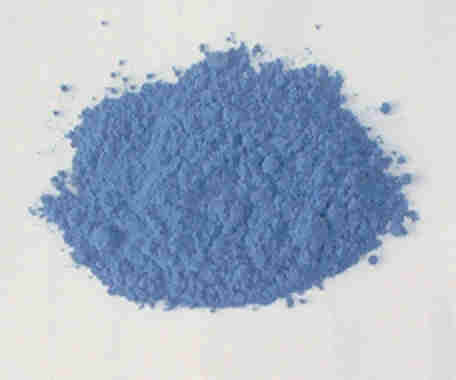
“Egyptian Blue” is a synthetic inorganic pigment made up of crystals of calcium-copper tetrasilicate (CaCuSi4O10), and is among the first synthetic inorganic materials that humans ever began to produce. The chemical combination of the pigment has also been identified in nature, but it is very rare, and synthetically it is produced in a complex process that requires heating and cooling for hours in precise and narrow temperature ranges, and under specific conditions.
The pigment was first identified archaeologically in ancient Egypt starting from 2,500 BC, and throughout its existence it was produced in large quantities, and was used for frescoes, ceramic glazes, faience, and glass. Its production declined after the Roman period, and by around the 9th century CE its use had all but ceased; the pigment was rediscovered only in the 19th century, possibly because its production was so complex.
Source and further reading
Warner, T. E. (2011). Synthesis, properties, and mineralogy of important inorganic materials. John Wiley & Sons, Incorporated. (Chapter 3, pp. 26–49)